
Space Weather Observations, Alerts, and Forecast


3-day Solar-Geophysical Forecast issued Jun 05 22:00 UTC

Solar Activity Forecast:
Solar activity is expected to remain very low with only a slight chance for an isolated C-class flare.

Geophysical Activity Forecast:
The geomagnetic field is expected to remain mostly quiet with isolated periods of unsettled conditions on day 1 (6 June) due to elevated solar wind speeds and brief periods of Bz south. Quiet to unsettled with intermittent periods of active conditions are expected on days 2 and 3 (7-8 June). The increase in activity is due in part to weak coronal hole effects expected on 7 June as well as the possible arrival of a slow moving CME on 8 June. The CME is from a filament that disappeared on 3 June. A weak halo can be observed on LASCO C3 coronagraph images from early 4 June as well as STEREO A and B coronagraphs from the same period.

Space Weather Alerts - Current Month

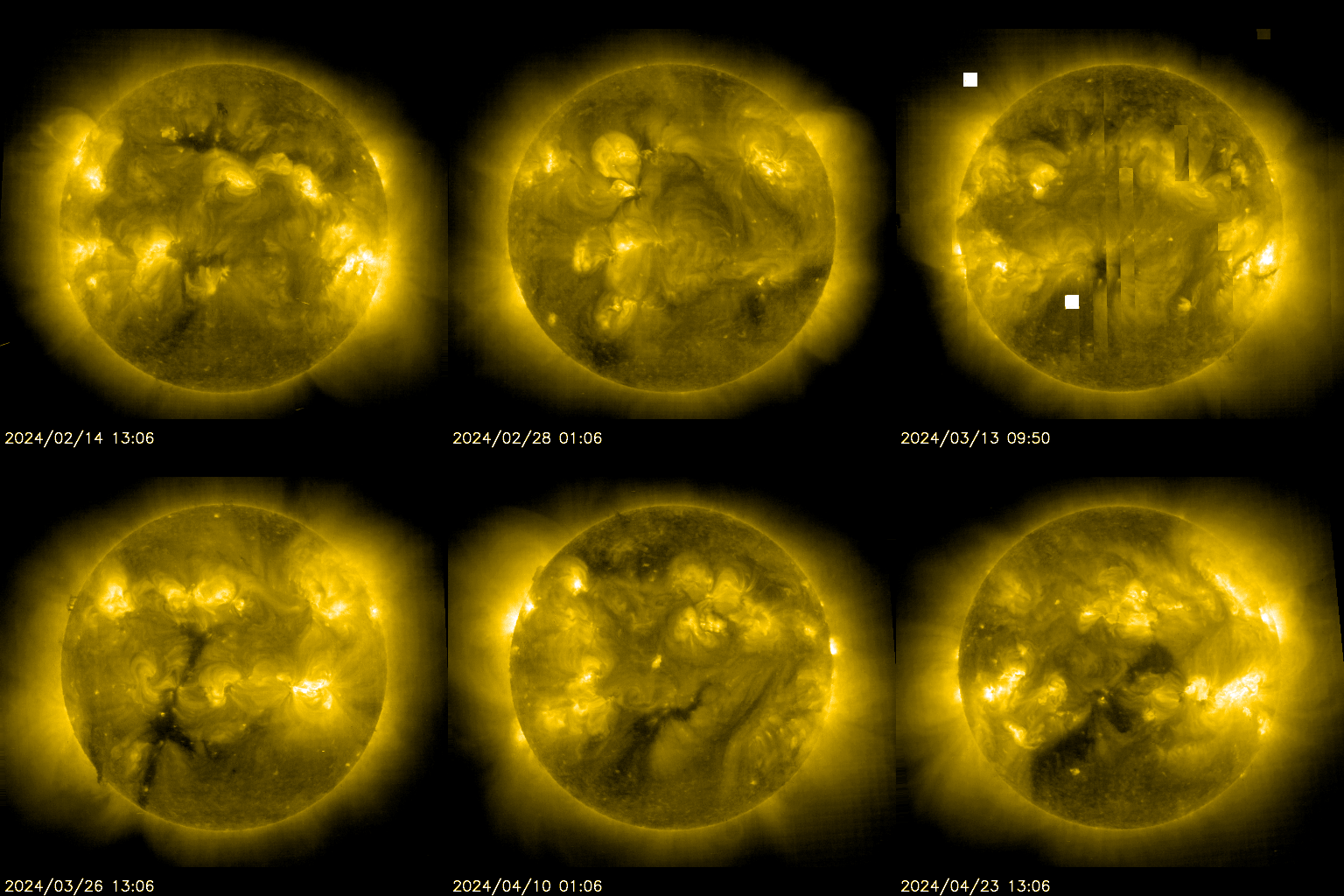
Real Time Images of the Sun


SOHO EIT 304
Click for time-lapse image of the sun
SOHO EIT 284
SOHO EIT 284 image of the sun
Mauna Loa Solar Image
Latest Mauna Loa image of the Sun

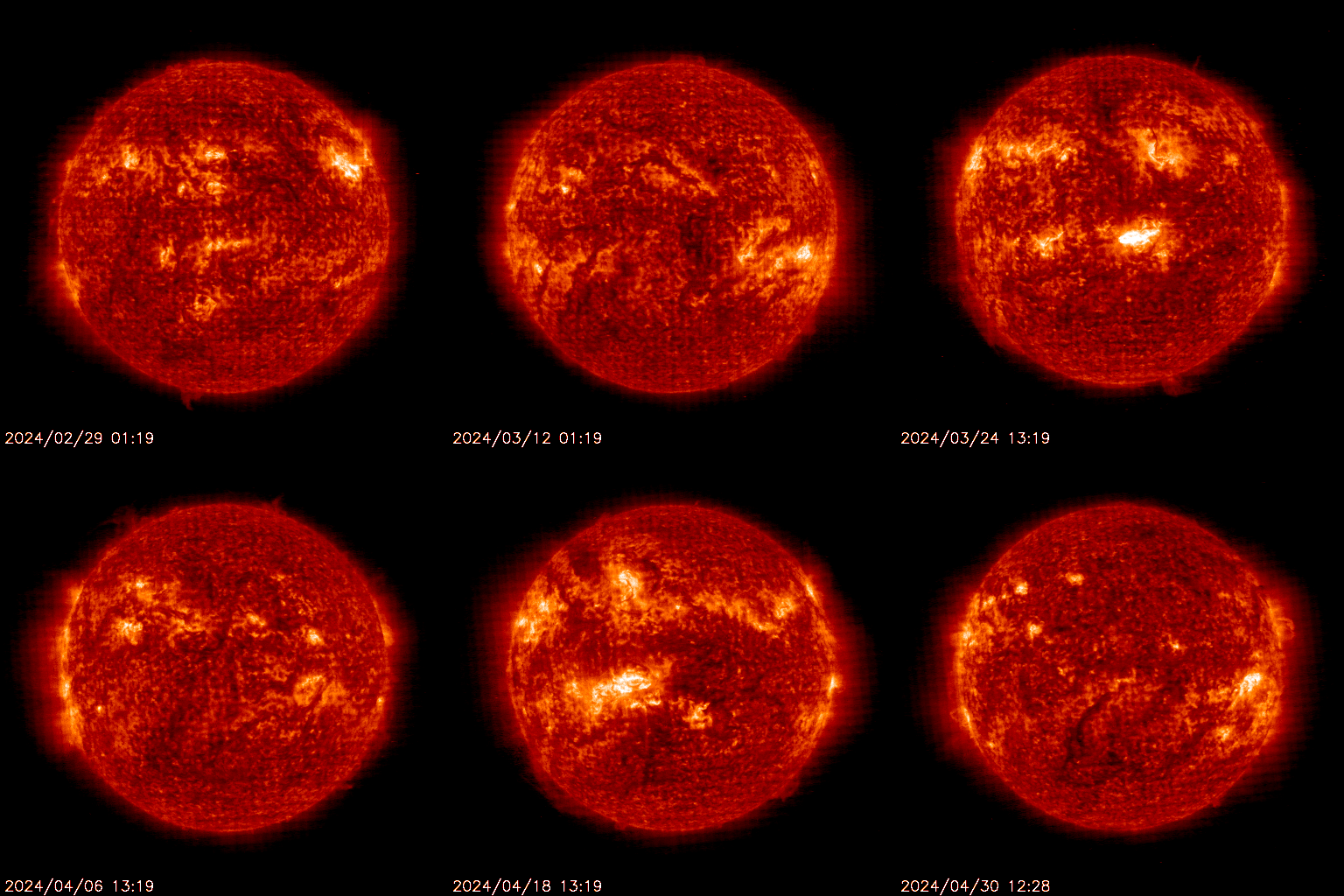
The sun is constantly monitored for sun spots and coronal mass ejections. EIT (Extreme ultraviolet Imaging Telescope) images the solar atmosphere at several wavelengths, and therefore, shows solar material at different temperatures. In the images taken at 304 Angstrom the bright material is at 60,000 to 80,000 degrees Kelvin. In those taken at 171 Angstrom, at 1 million degrees. 195 Angstrom images correspond to about 1.5 million Kelvin, 284 Angstrom to 2 million degrees. The hotter the temperature, the higher you look in the solar atmosphere.

Real Time Solar X-ray and Solar Wind


Solar Cycle Progression
Graph showing current solar cycle progression
Solar Cycle chart updated using the latest ISES predictions.
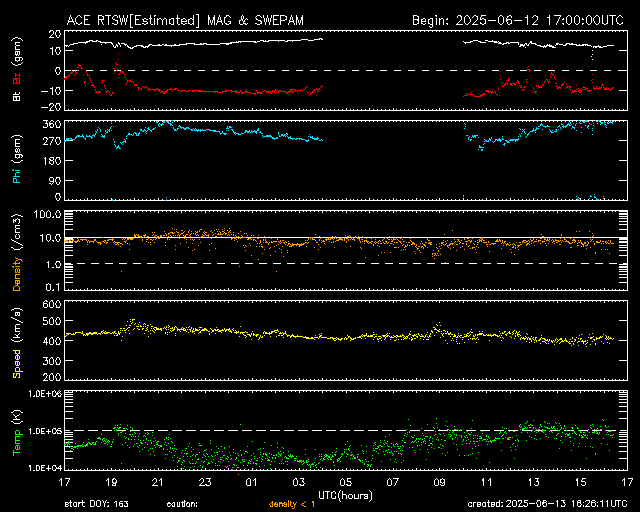
Real-Time Solar Wind
Graph showing Real-Time Solar Wind
Real-Time Solar Wind data broadcast from NASA's ACE satellite.

The Solar Cycle is observed by counting the frequency and placement of sunspots visible on the Sun. Solar minimum occurred in December, 2008. Solar maximum is expected to occur in May, 2013.

Solar X-ray Flux
Graph showing Real-Time Solar X-ray Flux
This plot shows 3-days of 5-minute solar x-ray flux values measured on the SWPC primary and secondary GOES satellites.
Satellite Environment Plot
Graph showing Real-Time Satellite Environment Plot
The Satellite Environment Plot combines satellite and ground-based data to provide an overview of the current geosynchronous satellite environment.

Auroral Activity Extrapolated from NOAA POES


Northern Hemi Auroral Map
Current Northern hemispheric power input map
Southern Hemi Auroral Map
Current Southern hemispheric power input map

Instruments on board the NOAA Polar-orbiting Operational Environmental Satellite (POES) continually monitor the power flux carried by the protons and electrons that produce aurora in the atmosphere. SWPC has developed a technique that uses the power flux observations obtained during a single pass of the satellite over a polar region (which takes about 25 minutes) to estimate the total power deposited in an entire polar region by these auroral particles. The power input estimate is converted to an auroral activity index that ranges from 1 to 10.


3 Day Report of Solar & Geophysical Activity

Prepared jointly by the U.S. Dept. of Commerce, NOAA,
Space Weather Prediction Center and the U.S. Air Force.

Updated 2013 May 22 2200 UTC

Joint USAF/NOAA Solar Geophysical Activity Report and Forecast
SDF Number 142 Issued at 2200Z on 22 May 2013


IA.  Analysis of Solar Active Regions and Activity from 21/2100Z to
22/2100Z: Solar activity has been at high levels for the past 24 hours.
The largest solar event of the period was a M5 event observed at
22/1332Z from Region 1745 (N13W80). There are currently 7 numbered
sunspot regions on the disk.

IB.  Solar Activity Forecast: Solar activity is expected to be low with
a chance for M-class flares and a slight chance for an X-class flare on
days one, two, and three (23 May, 24 May, 25 May).


IIA.  Geophysical Activity Summary 21/2100Z to 22/2100Z: The geomagnetic
field has been at quiet to active levels for the past 24 hours. Solar
wind speed, as measured by the ACE spacecraft, reached a peak speed of
500 km/s at 22/0442Z. Total IMF reached 6 nT at 22/2005Z. The maximum
southward component of Bz reached -5 nT at 21/2357Z. Protons greater
than 10 MeV at geosynchronous orbit reached a peak level of 279 pfu at
22/2035Z. Protons greater than 100 MeV at geosynchronous orbit reached a
peak level of 3 pfu at 22/1830Z. Electrons greater than 2 MeV at
geosynchronous orbit reached a peak level of 722 pfu.

IIB.  Geophysical Activity Forecast: The geomagnetic field is expected
to be at unsettled to active levels on day one (23 May), quiet to
unsettled levels on day two (24 May) and quiet to active levels on day
three (25 May). Protons are expected to cross threshold on days one and
two (23 May, 24 May) and are likely to cross threshold on day three (25
May).


III.  Event probabilities 23 May-25 May
Class M    50/50/50
Class X    20/20/20
Proton     99/99/70
PCAF       RED


IV.  Penticton 10.7 cm Flux
Observed           22 May 133
Predicted   23 May-25 May 125/125/130
90 Day Mean        22 May 122


V.  Geomagnetic A Indices
Observed Afr/Ap 21 May  008/008
Estimated Afr/Ap 22 May  009/012
Predicted Afr/Ap 23 May-25 May  012/012-007/015-012/008


VI.  Geomagnetic Activity Probabilities 23 May-25 May
A.  Middle Latitudes
Active                30/15/30
Minor Storm           10/05/15
Major-severe storm    01/01/05
B.  High Latitudes
Active                15/15/15
Minor Storm           30/25/25
Major-severe storm    40/25/45

Photo compliments of NOAA


Credits:

Space Weather Images and Information (excluded from copyright) courtesy of: NOAA / NWS Space Weather Prediction Center, Mauna Loa Solar Observatory (HAO/NCAR), and SOHO (ESA & NASA).

Space Weather links:
3-Day Forecast of Solar and Geophysical Activity
Space Weather Now
Today's Space Weather
Real-Time Solar Wind
Space Weather Outlooks
Space Weather Bulletins
Space Weather Alerts and Warnings
Space Weather Alerts - Current Month
Solar and Heliospheric Observatory (SOHO)
The Very Latest SOHO Images

Powered by Space Weather PHP script by Mike Challis


Google